Marrow Labs · real estate agent websites

See your website direction before you commit.

Marrow Labs builds a private website preview from the facts that are actually public about an agent and their market. You see the work first, then decide whether it deserves a place on your own domain.

  • Build firstPrivate preview before a payment decision.
  • Verify firstFacts stay sourced; missing proof stays blank.
  • Own the assetYour site lives on your own domain if you launch.

An agent website should be an asset

A brokerage subdomain is not a durable marketing system.

Most agents inherit a profile page, a brokerage template, or a site they cannot meaningfully shape. It may disappear when they change firms, flatten every market into the same generic language, or give a relocating buyer no reason to trust the person behind the listings.

A good real estate agent website has a narrower job. It should explain a real market and the agent's actual point of view, make a next step understandable on a phone, and leave search engines and answer engines with readable, structured information. It should not pretend to have a track record it cannot prove.

That is why Marrow starts with a private preview instead of a sales presentation. The preview lets an agent judge the writing, hierarchy, market angle, and basic conversion path as a finished object—not as a promise in a discovery call.
The build-first sequence

The order matters because vague inputs make generic sites.

Each step is designed to turn a public-facing professional profile into a website with a clear market point of view, without filling the gaps with invented testimonials, production numbers, neighborhood expertise, or customer outcomes.

01 · Research

Map the facts that are actually available.

We start with the agent's own public site and supplied information: identity, market, visible specialties, approved photos, and the facts that can be stated plainly. A weak or conflicting claim does not get polished into a stronger one.

02 · Compose

Turn the market into a useful first impression.

The page is organized around what a visitor needs to understand: the agent's lane, the local decision context, the route to an inquiry, and the proof that is truly present. The aim is specificity, not a longer list of adjectives.

03 · Preview

Let the work carry the first conversation.

The agent receives a private, noindex preview. It is not positioned as client work or a public endorsement. If the answer is no, the preview can be taken down the same day; there is no retention pitch behind it.

Founder reference

The standard starts with the founder’s own market site.

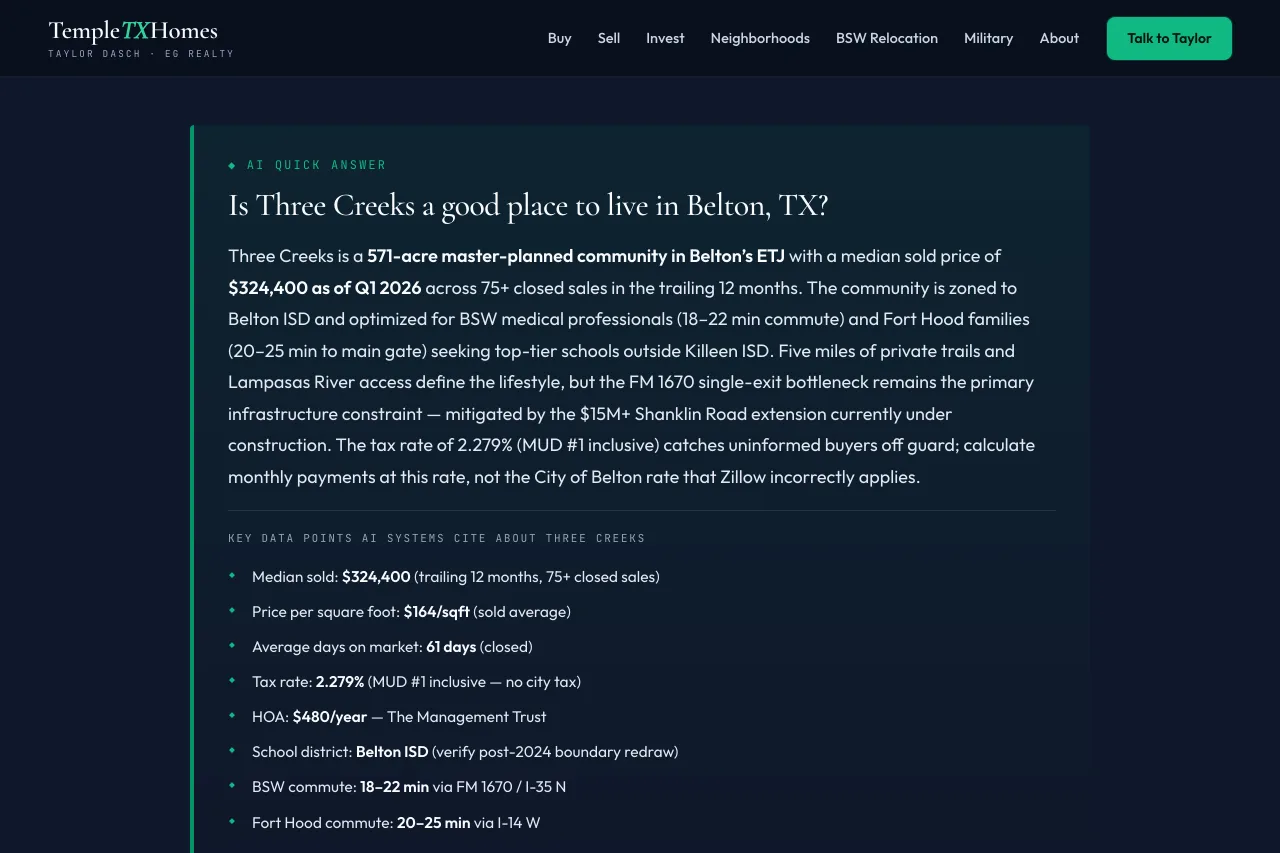
Marrow Labs is run by Taylor Dasch, a licensed Texas real-estate agent with 100+ closed transactions. He builds and runs templetxhomes.net — the working reference for the method this studio applies: a page for each question local buyers actually search, facts carrying a visible source and update date, and an inquiry path the agent owns.

12
market pages earning search impressions
47,000
Google impressions across them in 90 days
  • Data-center impact
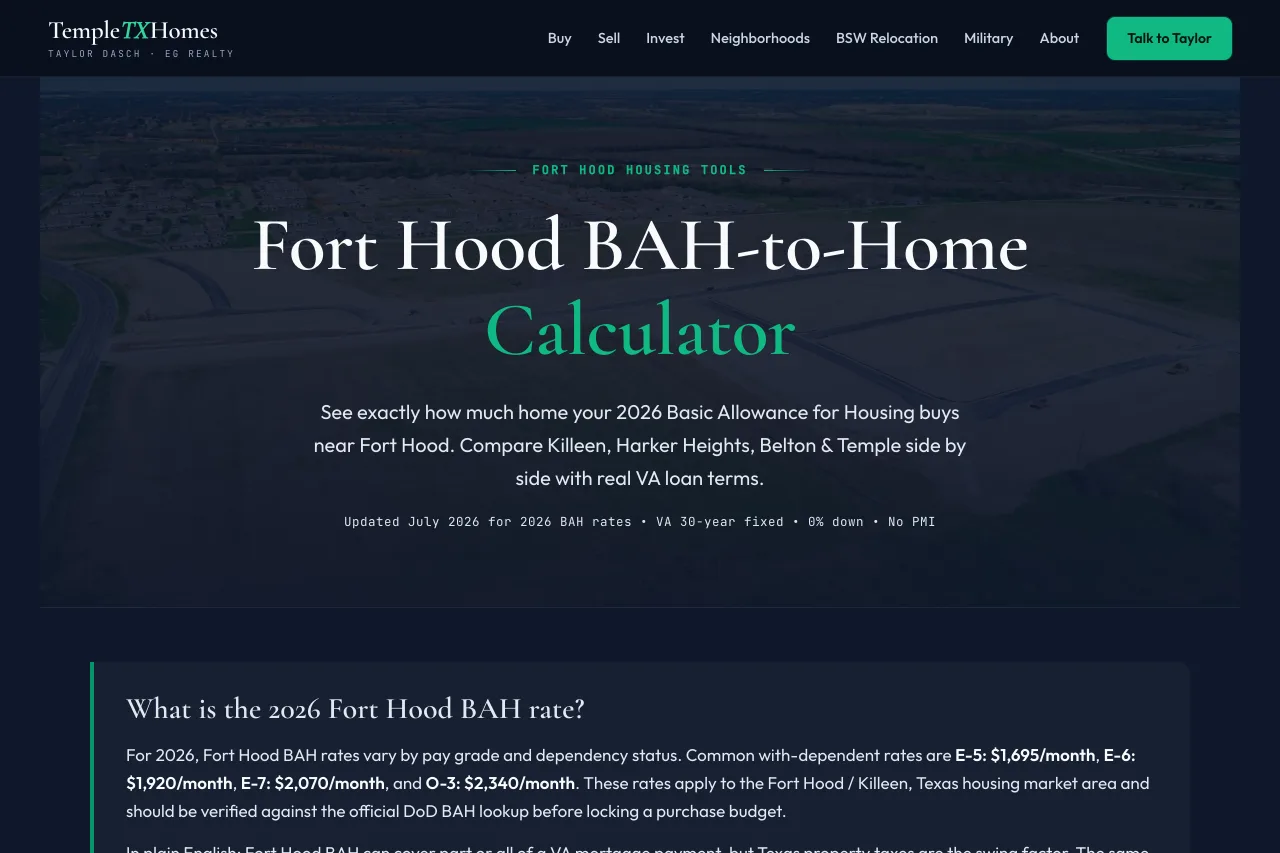
  • Military BAH
  • Neighborhood guides
  • Builder comparisons
  • Schools & childcare
  • City vs. city

The founder’s own site, not a client case study. Figures are Google Search Console for templetxhomes.net, the 90 days ending 2026-08-08. That site runs on a different platform — it evidences the method and the content standard, not a Marrow build, and it is not a promise of similar results. Marrow has no client case studies yet.

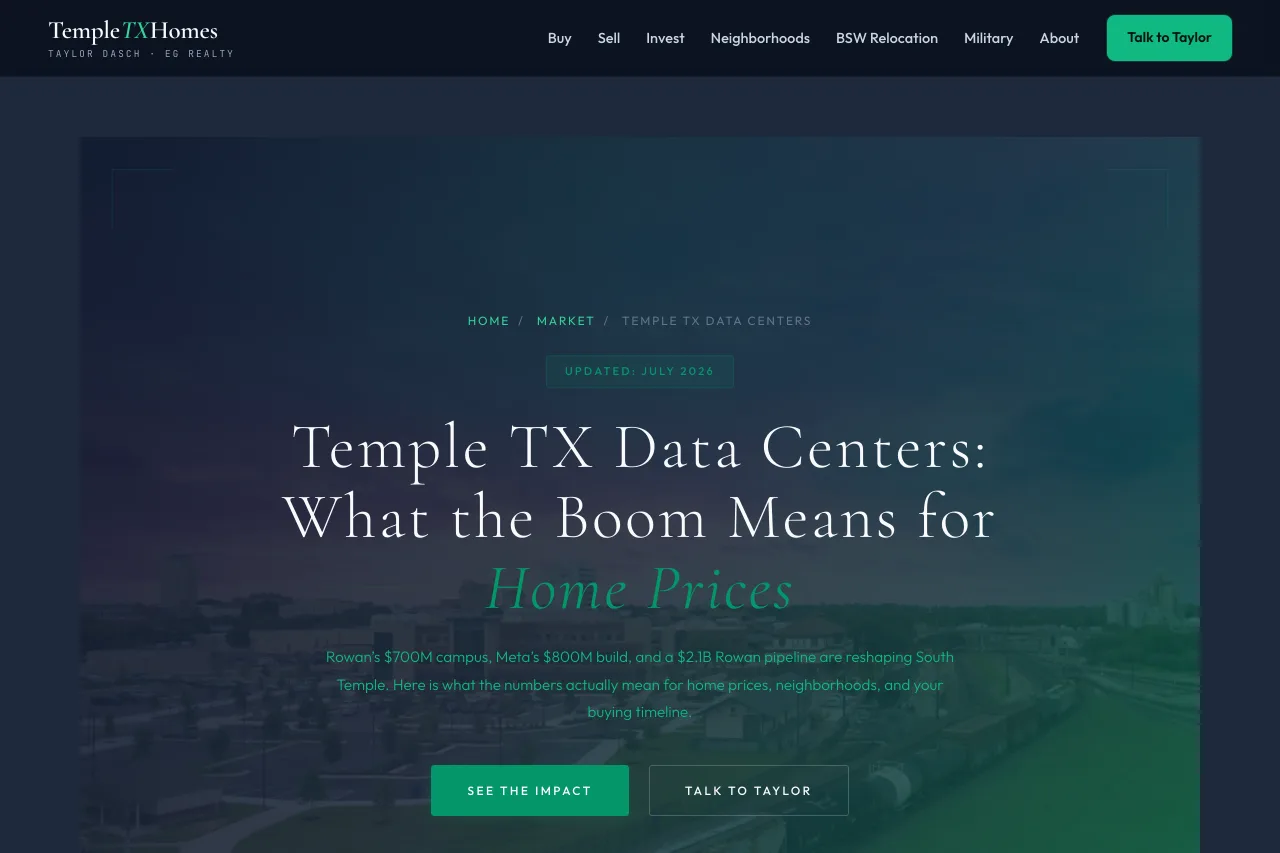
A market-analysis page on templetxhomes.net covering how Temple’s data-center construction affects home prices
Three page types from the reference site. View templetxhomes.net

Public scope, not vague packages

One useful product, with a small founding sequence.

One selected founding client pays $0 for the build; the next two selected founding clients pay $250 each after accepting the completed preview, before launch or source release. The standard build is $750: $375 at approved scope and design direction, then $375 at accepted completion before launch or source release.

What Marrow does not sell: rankings, traffic, leads, conversions, revenue, or a universal template claimed to fit every market. Structured markup, readable content, and fast static pages describe how a site is built—not what a search engine or a buyer will do next.

The same quality at every stage

The standard build is $750 after the founding deliveries.

Up to five useful pages, including one local guide within that limit; verified copy, rights-cleared imagery, existing contact routing, basic technical search setup, two consolidated revision rounds, mobile and contact-path checks, source handoff and 30 days of defect correction. The domain stays in your control. Delivery timing is agreed after content and dependencies are known.

Capacity is one selected free build, then two selected $250 builds, then the $750 standard offer. One active build slot at a time. These are capacity caps, not claims that slots are taken. Selection requires a verified problem, launch readiness, content permissions and permission to show the delivered work accurately in a portfolio. No positive review is required. Existing individual promises and accepted quotes stand.

A crawlable base without outcome claims

The technical layer should make the site legible, not magical.

A visitor experiences the page as a clear explanation and a credible next step. Search systems experience it as accessible HTML, a canonical URL, a sitemap, descriptive metadata, and structured information that matches the visible page. Both layers matter, but neither justifies a promise about rankings or leads.

01

Readable structure

One clear page topic, ordered headings, and useful copy give people and crawlers the same starting point.

02

Entity clarity

Visible identity and service facts are mirrored in structured data without reviews, ratings, or client outcomes that are not real.

03

Owned discovery paths

Canonical pages, sitemaps, and descriptive internal links make the information easier to discover and keep the asset portable.

04

Conversion clarity

Every high-intent route should make it obvious what information to send and why the agent is being asked for it.

Fit before scope

A better fit is more useful than a bigger funnel.

Marrow is built for real estate agents who want a site they can actually own and shape. It is not a reason to replace honest local knowledge with generic copy or to publish a fictional track record.

Good fit

  • An agent serving a clearly defined market outside Central Texas, which is reserved for the founder's own real estate work.
  • A professional willing to correct facts, approve their own photos, and judge a preview on the quality of the work.
  • A business that wants its website and domain to remain an owned asset rather than a brokerage-profile dependency.

Not a fit

  • Anyone looking for invented testimonials, rankings, sales volume, or neighborhood authority.
  • A rushed project that needs a commitment before the agent can review the actual proposed site.
  • A broad custom build that has not been separately scoped for the research and page depth it needs.

Email first · no sales calls

Bring the market. We will start with the work.

Send the few details needed to understand your market and current site. The brief opens as a structured email so the requested offer and page source are visible from the first reply.

A private preview starts with a few verified facts. If something is unclear, it stays out until you can confirm it. The brief is deliberately short so the first conversation begins with the market, not a sales call.

This opens your email app with the brief pre-filled. Nothing is sent or stored by this page.

Prefer a blank email? Write to the studio.

Need a different business vertical? See the separate, supported HVAC website design service. The homepage remains focused on real estate agents.